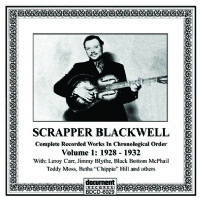
| Scrapper Blackwell Vol 1 1928 - 1932 £7.49 |
||
|
||
FEATURED ARTIST / S
|
| Black Bottom McPhail |
| Teddy Moss |
| Scrapper Blackwell |
TRACK LIST
|
|||||||||||||||||||||||||||||
|
|||||||||||||||||||||||||||||
BDCD-6029 Scrapper Blackwell Vol 1 1928 – 1932
Francis “Scrapper” Blackwell, vocal, guitar.
Including;
Leroy Carr, piano.
Bertha “Chippie” Hill, vocal
Teddy Moss, vocal.
Jimmy Blythe, piano.
Black Bottom McPhail, vocal.
Genres; “Country Blues”, Blues Guitar, Blues Guitar/Piano.
Informative booklet notes by Howard Rye.
Detailed discography.
Scrapper Blackwell’s career and reputation lie under a shadow. Its name is Leroy Carr. As the co-authors of the best-loved piano and guitar duets in blues history, their names are indissolubly linked in most accounts. Blackwell will inevitably be remembered first for his uncanny rapport with the pianist, yet his solo career began at the same time as the duets and he continued to make solo recordings throughout the duo’s life.
The success of the Carr/Blackwell duets kept the pair active. At the beginning of 1929, a couple of stylistic experiments were undertaken which had no successors. Non-Skid Tread sounds as if it was meant to be a contribution to the hokum boom in which Vocalion and its A&R man Mayo Williams were deeply involved, but it has a curiously non-hokum atmosphere. The identity of “The Two Roys” has inspired much speculation. Perhaps Leroy Carr is one of them but there is no evidence for recent suggestions that the other is trombonist Roy Palmer playing kazoo. Be-Da-Da-Bum, whose TC- matrix number reveals that it was originally a trial recording, is the only Carr/Blackwell duet on which Scrapper takes the vocal. It is a curious piece which starts off with double entendres about cats and drifts off into a collection of unrelated verses. A session on 4 February 1930 brought the guitarist into the studio without Leroy Carr to record two titles under his own name, six under Teddy Moss’s and two with “Robinson’s Knights Of Rest”. Only one of each was issued. His own Springtime Blues has a very melodic style. Moss delivers a wailing vocal with a continuous obbligato by a clarinettist who also appears with the Knights of Rest, who perform in the barrelhouse jazz style of twenties Chicago. The clarinettist mixes a New Orleans blues-style with some tasteless hokum and this has led some to fancy Arnett Nelson, notorious for this mixture, as a candidate. The problem is that this identification leaves no role for “Robinson”, but no one really knows who “Robinson” was anyway. Perhaps there wasn’t a “Robinson”.
On 24 November 1931, and again with Leroy Carr not present, Scrapper recorded his largest group of solo recordings, a fine set of performances. By this time Leroy Carr and Scrapper Blackwell were working extensively in the St. Louis area, but it was to New York City that they went for their only 1932 session, spread over three days in March. They recorded eight duets and then Scrapper recorded four accompaniments to one Black Bottom McPhail, who was thus given the opportunity to compare St. Louis and New York women, which he does on Mix That Thing. Discographers have perhaps been unnecessarily tentative in their attribution of these accompaniments to Blackwell.