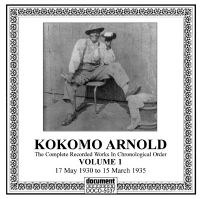
| Kokomo Arnold Vol 1 1930 - 1935 £7.49 |
||
|
||
FEATURED ARTIST / S
|
| Kokomo Arnold |
TRACK LIST
|
|||||||||||||||||||||||||
|
|||||||||||||||||||||||||
DOCD-5037 Kokomo Arnold Vol 1 1930 – 1935
Kokomo Arnold, bottleneck-slide guitar, vocal.
Genres; “Country” Blues, Georgia Blues, Early Chicago Blues, Bottlenck-slide Guitar.
Informative booklet notes by Keith Briggs.
Detailed discography.
Putting a bottleneck onto the little finger of the fretting hand and ‘sliding’ it up and down the strings of a guitar to produce a spine-chilling and almost vocal sound is a trick employed by many blues players. From Bukka White to Joe Louis Walker, many blues players have made startling use of the style, two of the most famous being Elmore James and James Kokomo Arnold. Kokomo, often placing his guitar in his lap Hawaiian-style and ran a glass across the strings. He was left-handed and had a somewhat erratic sense of time - but he was probably the fastest bottleneck guitarist ever to record.
On 17 May 1930 he was in Memphis, Tennessee, cutting a record for Victor under the pseudonym of Gitfiddle Jim. The two sides were outstanding - and, in the early depression, went nowhere. One was his own blues Rainy Night Blues and the other, Paddlin’ Blues, a manic, breakneck display piece with a vocal loosely based on the popular song “Paddling Madelaine Home”. Unimpressed by his own debut, Kokomo went back to Chicago and it was here that Kansas Joe McCoy, some-time husband of Memphis Minnie, heard him and introduced him to Mayo ‘Ink’ Williams who was producing records for Decca. Despite a lack of interest on the part of Kokomo, who was reluctant to leave his basement bootlegging business unattended, they finally got him into a studio on 10th September 1934 when he recorded four tracks. The first coupling released from this session produced a two sided hit. Old Original Kokomo Blues, a tune he remembered from a Jabo Williams recording, gave him his nickname and supplied the model for dozens of later variants, the most famous being Robert Johnson’s “Sweet Home Chicago” in which form it remains a blues standard to this day. Equally prolific was Milk Cow Blues which spawned no less than four more versions by Kokomo himself and saw reanimation in the rock and roll repertoires of Elvis Presley and Eddie Cochran in the fifties. Sagefield Woman Blues utilises the same tune as “Milk Cow” but includes the line “I believe I’ll dust my broom” another thread stretching between Arnold, Robert Johnson and Elmore James. To complete the session Arnold cut Charlie Spand’s Back To The Woods picking like a mad-man. The unexpected success of these recordings ensured that Mayo Williams got Kokomo back into the studio at the first opportunity - and kept him there for the next four years.