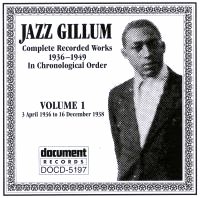
| Jazz Gillum Vol 1 1936 - 1938 £8.69 |
||
|
||
| Jazz Gillum CDs
His mothers brother, took Jazz and his brothers in to raise them. As a result of Ed being a church deacon, Jazz had the opportunity to learn to play the harmonium, better known as a pump organ, which
worked with forced air. Young Gillum picked up on it quickly and soon went on to learn the harmonica, which was basically a small and portable version of the pump organ.
Gillum and his brothers were unhappy with the way their uncle treated them and they all ran away from home before Bill was eight years old.He ended up living with relatives in Charleston, Mississippi, but he ran away from there when he was eleven. He ended up in Minter City and found work as a field hand. After working three years in the fields, Gillum found work at a drug store in nearby Greenwood. When he finishedwork at the drug store, he often played his harmonica on the streets for tips to supplement his income.Finally he followed the developing black drift and moved north to Chicago. In the Windy City Jazz kept up his casual involvement in music and gradually became part of the local scene. One of the musicians he played with was Big Bill Broonzy. Broonzy was now a studio musician and talent scout for the label and he brought Gillum to the attention of the A&R man, Lester Melrose. Bluebird was a new division of Victor Records. Victor Records formed Bluebird in order to put out less expensive recordings of Jazz and Blues records because of sliding sales during the Depression. Gillum recorded two sides for Bluebird in 1934, but since neither side generated any sales, it looked like the end of Gillum's relationship with Bluebird. These tracks were released as the two sides of BB B5565 but no copy is known to exist. Then, in January 1936, (a year and a half after the first Bluebird session), a British A&R man named Rex Palmer asked Bluebird if Gillum could record for the Regal Zonophone label. Bluebird responded with a letter stating that they did not have Gillum under contract, nor were they going to put out recordings by him in the future. Palmer again wrote to Bluebird because he wanted Gillum to record songs from musicals, such as the type found in Ginger Rogers and Fred Astaire movies. Bluebird responded with a letter that Gillum was Black and unable to read music and this would be an impossible task. As it turned out, the interest by Palmer lit the fire under Bluebird and they again recorded Gillum two days before they sent their last letter to Palmer. Gillum cut some sides for Vocalion in 1940 and he recorded 65 sides for Bluebird up to 1942. Then during World War II, there was a shortage of shellac and J.C. Patrillo, President of the American Federation of Musicians ordered a ban on all recordings. Gillum joined the Army in 1942 and served until 1945. About a year later, Bluebird came back to life anticipating that the Patrillo Ban would be lifted. However, it was another year before that happened. When Gillum got out of the Army, he went right back to playing and recording, but he still found it necessary to supplement his income by doing various day jobs. He recorded another 34 sides for Bluebird. In 1950, Victor ceased their Bluebird label operation because of the many new, independent labels that were entering the "race records" arena with the new sound of Blues. In Chicago, with the new breed of musicians, such as Muddy Waters, there was no longer a demand for Gillum's playing or recordings. During the 1950s, Gillum was like the invisible man on the Chicago music scene. Then, in 1961, Memphis Slim rediscovered Gillum and recorded him for both the Candid and Folkways labels. Even with the new, young white audiences now propelling a renaissance of the older Blues players, his career did nothing. Mike Bloomfield wrote a book about his travels with Big Joe Williams, and writes where they visited Gillum in 1962. It was 95 degrees outside and Gillum was inside his house, in front of his stove, with a coat on. His mental and physical condition declined rapidly. He managed to play a few dates at the Fickle Pickle in 1963, but that was the end of his public performing. On March 29, 1966, during an argument, he was shot in the head and was pronounced dead on arrival at Garfield Park Hospital in Chicago. He is buried at Restvale Cemetery in Worth, Illinois. Thanks is due to the writer of an article from the April 1998 edition of BluesNotes. |
||
FEATURED ARTIST / S
|
| Jazz Gillum More Titles? |
TRACK LIST
|
|||||||||||||||||||||||
|
|||||||||||||||||||||||