Document Records - Vintage Blues and Jazz

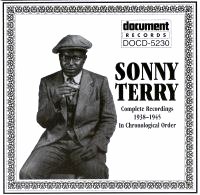
Sonny Terry Vol 1 1938 - 1945

£7.99   
 

As a youth, his eyes were injured in seperate accidents, the second at the age of sixteen. He could only see through one eye and that was "like looking through a spider web.'' So at a time when he'd planned on farming on his own, Terry was forced to rely on his music to make his living. He could still see well enough to work a little bit on his father's farm, but even before the second accident, he'd begun to play harmonica for money around Shelby, NC. (His family moved there some time between 1915 and 1922.) Terry even worked with a white group when he was fourteen; they would pick him up and take him to fish fries. He first heard blues in Shelby around this time and began to pick up blues songs from other musicians.

After his father died in an accident, Sonny moved in with his sister and began playing in Shelby and nearby towns with Bill Leach, a guitarist, and did his first tour with a medicine show. (The guy who ran the show began to cheat him, so Terry got his pistol and threatened the man, whom he remembered only as "Doc''. Doc didn't think Terry could see him, but the man was wearing white pants which Sonny could see well enough, so he shot Doc in the leg.) A brother had moved to Wadesboro, southeast of Charlotte, where Blind Boy Fuller's relatives lived. The two musicians visited there more or less regularly, so it was only a matter of time before they met. Fuller encouraged Terry to move to Durham, which he did. There, Fuller introduced him to his manager, J.B. Long; the two were sufficiently impressed with Sonny to have him record with Blind Boy Fuller. He also became a big part of the blues scene in Durham, though he also sold liquor and worked in a factory for the blind for a bit. Mostly, though, he played on the streets or in tobacco warehouses (where the big money was) with Fuller and washboard player George Washington (better known as Oh Red and Bull City Red). Starting at two in the afternoon, Fuller, Terry, and Red would make up to ten dollars in one day, enough to cover a week's worth of groceries for all. While in Durham, Terry also met Rev. Gary Davis, for whom he had great praise as a musician.

In 1937, Terry went to New York to record with Fuller and Floyd Council and appeared on Blind Boy Fuller songs in every recording session after that. At the same time, John Hammond was planning his now famous From Spirtuals to Swing concert at Carnegie Hall, and he wanted Blind Boy Fuller to appear. He arrived in Durham to find Fuller in jail, but heard a certain blind harmonica player who lived nextdoor to Fuller and signed him up. Bull City Red played the concert with Terry, whose music was exposed to a new audience. He continued to record regularly with Fuller and Red and was the only artist that Fuller backed on record. Fuller died in 1940, but Sonny Terry had already begun to record under his own name and, thanks to J.B. Long, was becoming well-known in his own right. And thanks to an invitation from Paul Robeson to play at a school in DC, he entered the next phase of his career.

At the urging of J.B. Long, Terry was accompanied to the concert by Brownie McGhee. Supposedly, McGhee went along to help look after Sonny and maybe get a chance to play, too, which he did. No sooner were they back in Durham than they got booked for a show in New York, which was followed by a series of concerts with Woodie Guthrie. The two did not return to the south and moved into a house on Sixth Avenue.

The duo became quite popular playing in white folk clubs and recording for a variety of small labels. They managed to appeal to the white revivalist movement (with people like Pete Seeger, Cisco Houston, and of course Woodie Guthrie) while their records still sold well to blacks outside of the Northeast. It was an almost unique accomplishment, at which the purists in blues were quick to sneer. The duo even made their impression on Broadway.

The recordings on this Document CD cover the years of 1938-1945 and range from a recording at Carnegie Hall with Bull City Red, to New York sessions with Blind Boy Fuller and Brownie McGhee, and also tracks recorded with Woody Guthrie. All of these selections feature Terry's distinctive vocals, which sometimes veered off-key, his falsetto whoops, and foot stomping. Terry's harmonica work is that of a virtuoso. His sence of dynamics and his ability to control the tone of his Harmonica through the cupping and uncupping of his hands, is unsurpassed by any of his peers.

Thanks are due to a Mr.T-bone, from where i lifted alot of this article. You can check out his web page at: T-Bones Blues Page

FEATURED ARTIST / S
Alonzo Scales More Titles?
Sonny Terry More Titles?

    TRACK LIST
    01 - Mountain blues (concert)
    02 - The new John Henry (concert)
    03 - Fox chase (2490-a)
    04 - Lost john (2493-b)
    05 - Train whistle blues
    06 - New love blues harmonica blues
    07 - Harmonica and washboard breakdown
    08 - Harmonica stomp
    09 - Harmonica and washboard blues
    10 - Forty-four whistle blues
    11 - Blowing the blues
    12 - Touch it up and go
    13 - John Henry
    14 - Fox chase (6503-a-2)
    15 - Fox chase (6503-a-3)
    16 - The red cross store
    17 - Glory
    18 - Lonesome train
    19 - Run away women
    20 - Shake down
    21 - Sweet woman
    22 - Fox chase (so-8)
    23 - Bonus tracks: Alonzo Scales (with Sonny Terry, 1955) Hard luck child
    24 - We just can`t agree
    25 - My baby likes to shuffle note: the remaining Alonzo Scales titles are on docd-5525.

Home SearchSpecials Services MP3'sArchive News Contact View Cart
ÿ