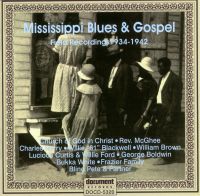
| Mississippi Blues & Gospel 1934 - 1942 £7.99 |
||
Available as a download. |
||
| These recordings present performances that have been previously unavailable on other CDs. They were recorded between 1934 and 1942 for the Library of Congress by John Lomax and his son, Alan Lomax, as they criss-crossed the rural south in search of authentic Southern American sound. Their quest yielded some of the finest examples of African-American religious expression in sacred songs. The Rev. McGhee of Clarksdale may or may not be Rev Ford Washington McGee who made many recordings in the 1920s. The career of that Rev. McGee is described by Ken Romanowski in the notes to BDCD-6031/32. Some think he might have been visiting Clarksdale at the same as the recordings took place but there is no real evidence either way. Charles Berry was recorded at the same time as Muddy Water's second session for the Library of Congress and plays second guitar on some of his recordings. Both these cornfield hollers are unaccompanied, projecting a stream of consciousness. The Willie Blackwell track Four O'Clock (Flower) Blues was recorded on the Arkansas shore after the party had been driven from Memphis by the police. According to Alan Lomax, William Brown was a markedly level headed person who had a 'sweet, true country voice' and was known for his delicate guitar playing. He identified 'Ragged and Dirty' as an archetypal Blues masterpiece. The recordings by George Boldwin, Lucious Curtis and Willie Ford were made by John A. and Ruby T. Lomax in Natchez in October 1940. It was difficult to find singers of secular songs because the town was still in mourning for the victims of a terrible dance-hall fire that April in which over 200 hundred people had died, including most of the Walter Barnes Band. Lucious Curtis was a musician by trade whose track "Time is Gittin' Hard" was previously recorded by Bo Carter as "Good Old Turnip Greens". Willie Ford took a day off from his regular work at a saw mill to record his track. "Country Girl Blues" is the only recording George Boldwin made. Booker T. Washington Bukka White is the best known artist in this collection and these two wonderful tracks were recorded whilst he was serving time for assualt. They were previously recorded on a very late 78 r.p.m. issued in 1967 which rejuvenated his career and bought his music to a new audience. The Frazier family were recorded by Alan Lomax during a "reconnaissance survey of folk music in Michigan". During this expedition he mostly found East European music but also the Frazier Family from Memphis. The family belonged, like other performers on this set, to the Church of God in Christ, source of much of the most influential African-American religious music. The song "Welfare Blues" belongs to a familiar group inspired by the Depression and its consequences. Blind Pete and Partner are described by John Lomax as "two street corner singers" whose repertoires contained mostly Blues songs. However it was decided to preserve two bad man ballads and some fiddle breakdowns for these recordings. Document feel that this compilation captures voices and music from the past, which evoke the deep and abiding cultural values of the African-American tradition. Acknowledgements: Alan Lomax, "Land Where the Blues Began", 1993 Tony Russell, " Talking Blues: Blind Pete" Jazz & Blues, Vol. 1, No. 10 (Febuary 1972), p.25 | ||
FEATURED ARTIST / S
|
| Willie '61' Blackwell More Titles? |
| Blind Pete & Partner More Titles? |
| George Boldwin More Titles? |
| William Brown More Titles? |
| Charles Berry More Titles? |
| Church of God in Christ More Titles? |
| Lucious Curtis More Titles? |
| Willie Ford More Titles? |
| Frazier Family More Titles? |
| Rev. McGhee More Titles? |
TRACK LIST
|
|||||||||||||||||||||||||
|
|||||||||||||||||||||||||