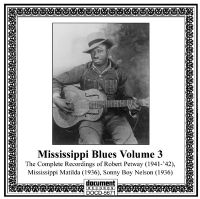
| Mississippi Blues Vol. 3 Complete Recordings of Robert Petway, Mississippi Matilda, Sonny Boy Nelson £8.69 |
||
Available as a download. |
||
| It is remarkable, given the later ubiquity of 'Catfish Blues', how little solid information
there is about Robert. He was born about 1908, probably on the J.F. Sligh Farm near Yazoo City, like his running buddy, Tommy McClennan. His publicity photograph shows a small man with a toothbrush moustache, a lantern jaw, and big, guitar player's hands. Most unusually, he apparently saw no reason to don the sharp suit and hand painted tie so often favoured by musicians (Tommy McClennan included) when facing the camera; photographed in his working man's blue duckins, Petway's only concession to style was a rakishly angled trilby. McClennan and Petway would play at house parties, and in the juke joint at Three Forks crossroads, nowadays famous as the place where Robert Johnson was poisoned. It was another decade, though, before Robert Petway became a recording artist, and Tommy McClennan, brought to Chicago by Lester Melrose in 1939, had made two dozen sides at three sessions by the time Petway came to the microphone in March 1941. The first bars of 'Catfish Blues' locate his music squarely in the gravel-voiced, rhythm-dominated tradition usually thought of as typical of the Mississippi Delta; the song chugs implacably on, powered by a monochordal riff. In the context of blues recordings of the time, Petway sounds anachronistic, but as Paul Oliver (YONDER COME THE BLUES) has pointed out: 'blues singers whom we mentally associate with one point in time by the date of their recordings, tended always to play in much the same way, both before and after cutting their few tracks.' Despite those big hands, Petway was no guitar virtuoso, but he ably exploited his National Steel's capacity for volume, and made effective use of the trademark triplet runs which can be heard in many of his songs; during 'Ride 'Em On Down' he varies the device, providing instead an exciting rush of sixteenth notes. Like McClennan, Robert favoured a dramatic vocal delivery, growling out the lyrics, bearing down hard on the beat, and encouraging himself with spoken asides. Petway's second and last session, a year later was held immediately after a session by Tommy McClennan (which was also McClennans last session as it turned out). It was perhaps Tommy's presence and example that encouraged Robert to crank up the energy a notch, coming closer to the more manic level attained by Tommy's version of their joint style. Eight titles were recorded, of which six were issued; the high point of the set came half way, when McClennan joined Petway (and Alfred Elkins, heroically plunking his one string bass) on 'Boogie Woogie Woman', one of the most exhilarating recordings of this or any other era, and as close as we shall ever get to Saturday night at the Three Forks juke. Robert Petway's recording career ended with a 'Cotton Pickin' Blues' that draws on the realities of his life, and thereafter he fades from view almost completely. According to Honeyboy Edwards: 'he moved to Blytheville, Arkansas, he was picking cotton there, then he come to Chicago.' Honeyboy heard that Petway was living on the north side, but never made contact, and 'nobody I know heard what become of him.' It is Catfish Blues that remains so influential... The great Muddy Waters later borrowed some of the lyrics (a Blues tradition,) and recorded his classic song, "Rolling Stone". Muddy also recorded another tune with the same type of riff called "Still a Fool". Much later, in the late 60's, Jimi Hendrix would perform a combination of these two Muddy Waters tunes and call it, appropriately enough, "Muddy Water Blues", later changing the title to "Catfish Blues". |
||
FEATURED ARTIST / S
|
| Robert Petway More Titles? |
| Mississippi Matilda More Titles? |
| Sonny Boy Nelson More Titles? |
| William Harris More Titles? |
TRACK LIST
|
||||||||||||||||||||||||||
|
||||||||||||||||||||||||||