
More Articles
151 to 155 of 155 Licensing “If it’s vintage, ask Document” 31 January 2005 More... Hey, Lawdy Mama. A snip at $5,250 for a blues 78! 31 January 2005 More... Scorsese`s 31 January 2005 More... From The Attic 31 January 2005 More... BLUES WORLD Magazine 31 January 2005 More... 151 to 155 of 155
|


Bukka White music CDs
Bukka White music CDs available from Document Records. Document Records have an extensive back catalogue of Bukka White music CDs. Each link will take you through to a page with a more comprehensive description of the particular Bukka White music CD title you are interested in:
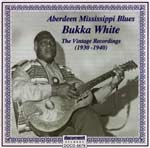 Bukka White Aberdeen Mississippi Blues DOCD-5679. Along with Son House and Skip James, Bukka White was one of the major Mississippi bluesmen to be re-discovered during the great blues revival of the 1960’s. His early recordings made between 1930 and 1940 are among the most creative and dynamic blues ever recorded. Click here for further information
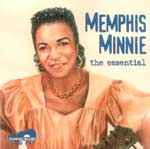 Memphis Minnie, the essential DOUBLE CD CBL 200001. Taken from the Document Catalogue, this double CD is a solid collection of some of the finest tracks performed by Memphis Minnie, one of the most influential female country blues singers to have ever recorded.
Click here for further information
 Mississippi Blues & Gospel 1934 - 1942 DOCD-5320. Though there is a general association with Mississippi, this collection of Library of Congress recordings is unified mainly by its unavailability on other CDs. The first nine titles included come from a recording project sponsored jointly by the Library and Fisk University in 1941/42 and the three religious recordings which open the set have never been released in any form.
Click here for further information
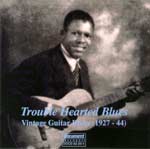 Troubled Hearted Blues DOCD-32-20-04. Twenty four tracks of some of the finest blues guitar on record. Includes superb bottleneck guitar playing by Robert Lockwood, Gabriel Brown and Bukka White, stunning finger picking by George Torey, Robert Wilkins and Blind Lemon Jefferson and much more.
Click here for further information
Booker T. Washington (Bukka white) was born in Aberdeen, Mississippi, November 12, 1906 . An early blues musician, Bukka White, may not have sold as many records as his contemporaries from Mississippi such as Elvis Presley and B.B. King, but his music endures to this day.
ukka White learned his trade from his father who was a railroad worker and part-time musician. John White was a multi-talented musician, playing piano, drums, saxaphone and mandolin. Bukka White`s mother, Lula White, was a preachers daughter and often sang hymns to her children. Bukka White got his first guitar at the age of nine and began playing immediately. With the musical influence of his family,
Bukka White was also influenced by blues artists such as Charley Patton and George "Bullet" Williams. As a teenager Bukka White worked as a field hand by day and in the evenings played many of the local juke joints and parties. But it wasn`t until 1930 that Bukka got his musical breakthrough when Ralph Lembo, who worked for the Victor label, sent White to record some of his songs in Memphis (some of the tracks from this session can be found on Document Records DOCD-5679).
In 1934 he married the niece of George "Bullet" Williams. Although newly married, Bukka spent alot of time on the road, hoboing around to such cities as St. Louis, Cincinnati, Cleveland, Baltimore, New York etc. Whilst doing this he earned extra money when not playing by fighting in professional boxing matches and as a semi-professional baseball player.
White was a fierce fighter as well as a fierce guitar player. He has been quoted as saying: "I play so rough - I stomp `em - I don`t peddle `em". The year of 1937 was a mixed one for Bukka White, he was imprisoned for shooting a man in the leg at the infamous Parchman Prison Farm, this however did not stop him from playing music. In the September of that year Bukka recorded one of his hit songs "Shake `Em All Down" for the Vocalion label.
Of his stay at Parchman Bukka was to say "Well, I mostly played guitar." Bukka went on to record two more songs for the Library of Congress in 1939. When released from prison in 1940, Bukka traveled to Chicago to record more tracks for the Vocalion label.
During the 1950`s Bukka`s musical career was at a standstill. He worked for as a laborer and worked at Newbury Equipment in Memphis. It wasn`t until 1963 that Bukka was was rediscovered after which he made many more recordings and became a favourite among fans attending blues festivals internationally.
He died in 1977 at the age of 71.